

Research, demonstration & innovation
Australia puts A$32.6 million behind carbon-management demonstrations
On September 2, Australia announced up to A$32.6 million in second-round funding under its Carbon Capture Technologies Program. Awards include A$10 million for enhanced rock weathering on agricultural land and A$10 million for an integrated direct-air-capture and CO₂-storage demonstration, along with projects involving mineral carbonation, carbon-storing concrete and hydrochar. Source: Australian Department of Climate Change, Energy, the Environment and Water
Finland awards €26.6 million for industrial biogenic-CO₂ capture
On September 9, Finland awarded €26.6 million to three industrial biogenic-carbon-capture projects. In the selected projects, the captured CO₂ will be used to produce electrofuels rather than permanently stored, so the projects themselves are not carbon removals. The underlying investment-aid program permits support for either permanent storage or utilization and is intended to expand industrial biogenic-CO₂ capture capacity. Source: Finnish Ministry of Economic Affairs and Employment
Demand & procurement
EU Buyers Club advances permanent-removals track
On September 10, the European Commission held the latest development session for the permanent-removals track of its Carbon Removals and Carbon Farming Buyers Club. The Commission says the program is intended to facilitate long-term or multi-year offtake agreements for large DACCS, BioCCS and biochar projects and help projects reach final investment decisions by linking demand with EU and member-state funding. Source: European Commission
Markets & incentives
Canada explores international carbon-market framework that includes removals
On September 24, Environment and Climate Change Canada announced that the federal government is exploring a framework for trading internationally transferred mitigation outcomes under Article 6 of the Paris Agreement. The government explicitly identified carbon-removal technologies and nature-based solutions as potential beneficiaries and said the framework could help Canada develop a globally competitive carbon-removal industry. Source: Environment and Climate Change Canada
Rules, standards & MRV
Australia completes 2026 review of national carbon-credit system
On September 1, Australia’s Climate Change Authority released its fifth review of the Australian Carbon Credit Unit Scheme. Its six recommendations address permanence and reversal risk, use of 25-year permanence credits, public and First Nations benefits in government purchasing, market transparency, and capacity and coordination in methodology development. The government must respond to the recommendations; the review itself does not change the rules. Source: Australian Climate Change Authority
UNFCCC experts publish draft reversal-risk tool for Article 6.4
On September 17, the Methodological Expert Panel supporting the Paris Agreement Crediting Mechanism published a draft methodological tool for assessing reversal risk. The document is a recommendation from the expert panel rather than a final adopted rule and forms part of ongoing work on the treatment of removals under Article 6.4. Source: UNFCCC
New Zealand finalizes voluntary-market endorsement criteria
On September 21, New Zealand published final government endorsement criteria for domestic voluntary nature and carbon-market schemes. The framework covers scheme governance and integrity, conformity assessment, and requirements for project validation and verification. It follows the draft criteria released for consultation in July. Source: New Zealand Ministry for the Environment
Washington State begins work on permanent-sequestration standard
Washington’s Department of Ecology opened recruitment in September for a technical working group on permanent CO₂ sequestration under the state’s Cap-and-Invest Program. The group will examine permanence, geological sequestration, mineralization, regulatory approaches, voluntary-market methodologies and environmental and community impacts as part of a multi-year carbon-management process that also encompasses technology-based CDR. Source: Washington State Department of Ecology
Infrastructure & permitting
The developments below concern conventional CCS or shared CO₂ infrastructure rather than carbon removal itself. They are included because geological storage, transport systems and cross-border rules can also provide enabling infrastructure for DACCS, BioCCS and other durable CDR pathways.
Norway and the Netherlands open cross-border CO₂ chain
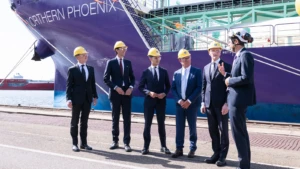
On September 7, the Norwegian and Dutch prime ministers opened Yara’s carbon-capture facility at Sluiskil in the Netherlands. Norway describes the project as the world’s first complete cross-border chain for capturing, transporting and permanently storing CO₂, with captured industrial CO₂ transported for storage on the Norwegian continental shelf. Source: Government of Norway
Canada begins construction of Alberta storage hub
On September 9, the governments of Canada and Alberta joined the groundbreaking for the Origins CCS Hub near Clive, Alberta. Operations are expected to begin in January 2027, with initial permanent-storage capacity of up to 1.5 million tonnes of CO₂ per year and the possibility of later expansion. Its initial customers are industrial emitters. Source: Natural Resources Canada
Malaysia advances work on bilateral cross-border storage agreements
On September 15, Malaysia’s Ministry of Economy reported discussions with government representatives from Japan and South Korea aimed at advancing bilateral agreements for cross-border CCS. The talks form part of Malaysia’s effort to develop regional CO₂ transport and storage value chains. Source: Malaysia Ministry of Economy — MyCCUS
Denmark inaugurates commercial offshore CO₂ storage chain
On September 18, Greensand Future inaugurated what the European Commission describes as Europe’s first commercial-scale, fully integrated value chain for capture, transport and permanent offshore CO₂ storage. The project received €41 million from the EU Innovation Fund and aims to store roughly 2.4 million tonnes of CO₂ over eight years, with infrastructure designed for later expansion. Source: European Climate, Infrastructure and Environment Executive Agency
Austria proposes replacing geological-storage ban with regulatory framework
On September 22, Austria submitted a ministerial draft that would repeal the country’s prohibition on geological CO₂ storage and establish a new Carbon Dioxide Storage Act. The proposal is intended to create a legal framework for permanent, safe and environmentally compatible geological storage. It remains a draft under consultation rather than enacted law. Source: Austrian Parliament
Finance & risk-sharing
Netherlands allocates €1.3 billion for carbon storage
The Dutch government’s September 15 budget package makes €1.3 billion in subsidy funding available for carbon storage, with the stated purpose of mobilizing investment in the energy transition. Source: Government of the Netherlands
National strategy
Germany sets out three-part approach that includes technical CDR
On September 2, Germany’s environment ministry described the federal government’s climate approach as combining emissions reductions, stronger natural carbon sinks and technical carbon dioxide removal. Germany is coordinating a long-term strategy for atmospheric CO₂ removal that is intended to provide a framework for scaling technical and other novel sinks and a basis for technical-sink targets under the Federal Climate Action Act. The ministry also said it is developing investment support and market incentives for new CDR technologies. Source: German Federal Environment Ministry
International strategy
UNEP publishes new framework for navigating 1.5°C overshoot
On September 2, UNEP released Limiting Overshoot, concluding that exceeding 1.5°C is now widely assessed as unavoidable under current policies and alternative near-term trajectories. The report frames the remaining challenge around limiting the height and duration of overshoot, reaching peak warming and subsequently bringing temperatures down, with carbon dioxide removal forming part of pathways that achieve net-negative emissions and temperature decline. Source: UN Environment Programme
Carbon dioxide removal as a waste product
Switzerland requires federal administration to use negative-emissions technologies for remaining emissions
On September 9, the Swiss Federal Council adopted amendments to its Climate Protection Ordinance implementing the federal government’s 2040 net-zero requirement for the central federal administration. The administration is expected to reduce emissions as far as possible and, beginning no later than 2040, completely balance remaining emissions using negative-emissions technologies that remove CO₂ from the atmosphere and store it permanently. The amendments take effect November 1. Source: Swiss Federal Office for the Environment